Introduction
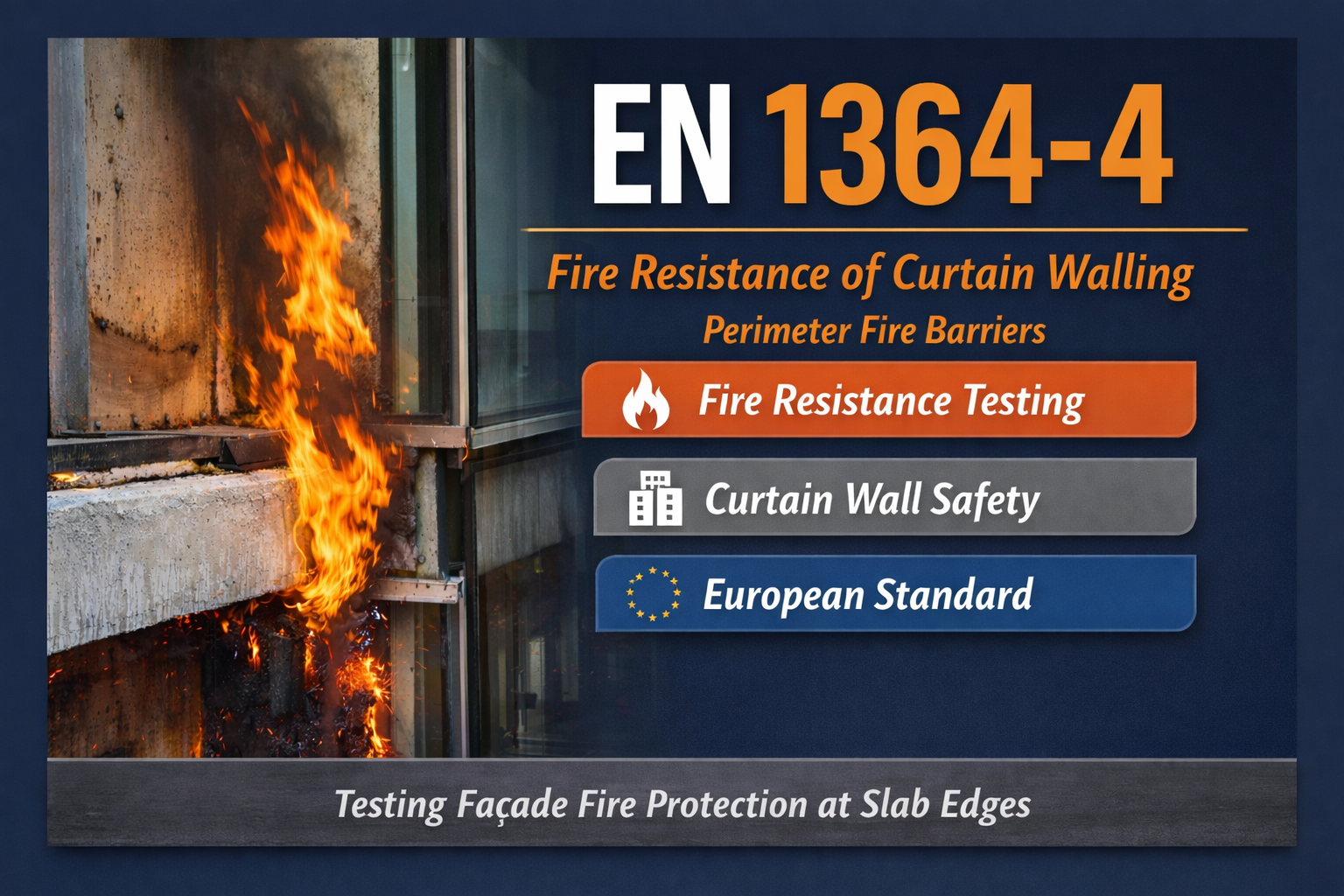
EN 1364-4 is a European fire test standard that defines the method for determining the fire resistance of curtain walling systems, including the perimeter fire barrier at the floor-to-façade interface. The standard is developed under the framework of CEN (European Committee for Standardization) and is widely used across Europe for façade fire compliance.
The standard addresses one of the most critical fire safety risks in modern buildings: vertical fire spread through slab edges and curtain wall interfaces.
Purpose of EN 1364-4
The primary purpose of EN 1364-4 is to evaluate how effectively a curtain wall and its associated perimeter fire barrier can:
- Maintain fire integrity during fire exposure
- Limit heat transfer to the non-fire side
- Prevent fire spread between building compartments
Unlike product-level tests, EN 1364-4 assesses the performance of the complete system, reflecting real façade construction practices.
What EN 1364-4 Tests
EN 1364-4 evaluates the fire resistance of:
- Curtain wall systems
- Perimeter fire barriers at slab edges
- Interfaces between floor slabs and façade assemblies
- Supporting framing and fixing details
The test is conducted under controlled fire exposure to assess how the assembly performs when subjected to fire from the interior side of the building.
Key Features of EN 1364-4
1. Standardized Fire Exposure
The test uses a regulated fire curve to simulate severe internal fire conditions impacting the curtain wall and slab edge.
2. Integrity and Insulation Criteria
Performance is evaluated based on:
- Integrity (E): Resistance to flame and hot gas penetration
- Insulation (I): Limiting temperature rise on the unexposed side
3. System-Level Evaluation
EN 1364-4 focuses on the interaction between façade systems and fire barriers, rather than isolated materials.
4. European Regulatory Alignment
Results from EN 1364-4 testing are used to support compliance with European building regulations and national fire codes.
Why EN 1364-4 Is Important
Façade Fire Safety
Curtain walls can create concealed paths for fire spread. EN 1364-4 helps verify that these risks are effectively controlled.
Regulatory Compliance Across Europe
The standard is recognized across EU member states and supports CE-marked façade systems.
Design Confidence for High-Rise Buildings
Architects, façade engineers, and fire consultants rely on EN 1364-4 test data when specifying compliant curtain wall systems.
Benchmark for Manufacturers
Façade system manufacturers use EN 1364-4 testing to demonstrate performance and market readiness.
Applications of EN 1364-4
EN 1364-4 is commonly applied in:
- High-rise commercial and residential buildings
- Curtain wall and glazed façade systems
- Airports, hospitals, and public buildings
- Office towers and mixed-use developments
Relationship to ASTM E2307 and IS 18190
While ASTM E2307 and IS 18190 use multi-storey test arrangements to simulate vertical fire spread, EN 1364-4 typically evaluates fire resistance under single-storey conditions. Despite this difference, all three standards share a common objective: preventing fire spread at the slab-to-façade interface.
Together, they form a globally relevant framework for perimeter fire barrier and façade fire safety testing.
Conclusion
EN 1364-4 is a key European standard that establishes a reliable and structured method for evaluating the fire resistance of curtain wall systems and perimeter fire barriers. By focusing on system-level performance and real façade interfaces, it plays a critical role in improving fire safety in modern European buildings.
As façade designs continue to evolve, EN 1364-4 remains an essential reference for safe, compliant, and performance-based façade construction.