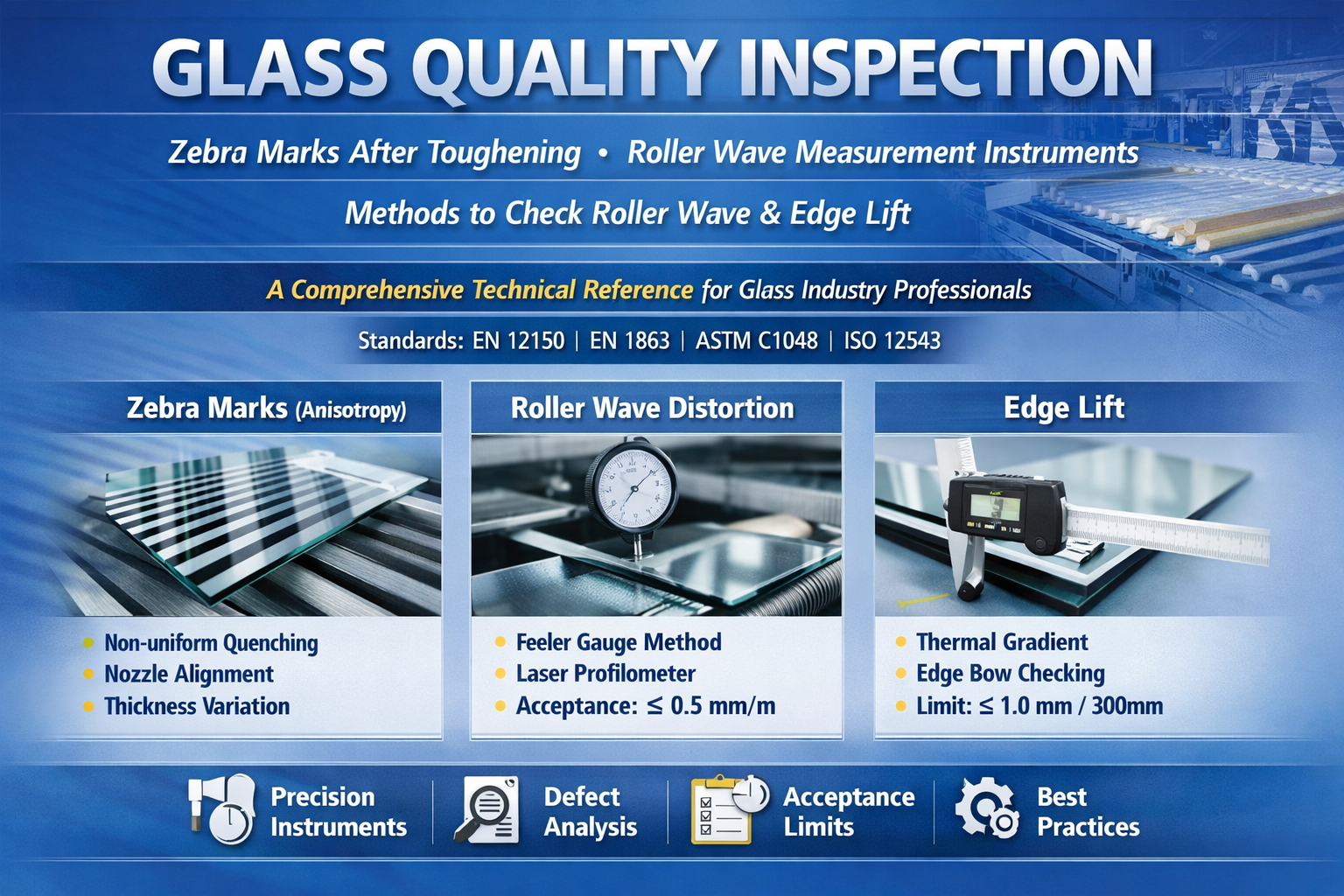
GLASS QUALITY INSPECTION
Zebra Marks After Toughening
Roller Wave Measurement Instruments
Methods to Check Roller Wave & Edge Lift
A Comprehensive Technical Reference for Glass Industry Professionals
Standards: EN 12150 | EN 1863 | ASTM C1048 | ISO 12543
1. INTRODUCTION TO GLASS QUALITY INSPECTION
Glass quality inspection is a critical process in the manufacturing of toughened (tempered) and heat-strengthened glass. Visual and instrumental methods are used to evaluate optical distortion, surface irregularities, and edge quality. Among the most important quality indicators are:
Zebra marks (anisotropy)
Roller wave distortion
Edge lift
Key Standards Covered:
EN 12150-1 – Toughened soda lime silicate glass
EN 1863-1 – Heat strengthened glass
ASTM C1048 – Heat-treated flat glass
ISO 12543 – Laminated glass
EN ISO 14438 – Energy balance determination
2. ZEBRA MARKS (ANISOTROPY)
Zebra marks are optical patterns visible in toughened glass under polarized light. They appear as alternating dark and light bands.
Causes:
Non-uniform quenching
Nozzle misalignment
Glass thickness variation
Furnace roller marks
Edge stress concentration
Tin bath residue
Inspection Method:
Use Zebra Board (anisotropy checker)
Inspect at 45° angle
Rotate glass 90°
Use polarized light
Check zones (Central, Peripheral, Edge)
Acceptable Distortion (EN 12150):
Zone A (>100mm from edge): ≤ 2mm/m
Zone B (50–100mm): ≤ 3mm/m
3. ROLLER WAVE IN TOUGHENED GLASS
Roller wave is periodic surface distortion caused by sagging between furnace rollers during heating (~640°C).
Key Influencing Factors:
Glass thickness (3–19mm)
Furnace temperature (620–660°C)
Roller spacing (100–150mm)
Travel speed (1–6 m/min)
Roller diameter (50–80mm)
Measurement Methods:
Straight edge + feeler gauge
Bow gauge / dial indicator
Laser profilometer
Optical deflectometry
Moiré fringe analysis
Structured light scanners
Straight Edge Method Steps:
Place glass on flat table
Place 1000mm straight edge perpendicular to roller direction
Insert feeler gauge at max gap
Record 5 readings
Calculate: Wave (mm/m) = Max Gap / 1m
Compare with EN 12150 limits
Acceptance Limits:
Standard toughened: ≤ 0.5 mm/m
Architectural: ≤ 0.3 mm/m
Heat strengthened: ≤ 0.5 mm/m
Laminated toughened: ≤ 0.3 mm/m
4. EDGE LIFT (EDGE CURL / SHELL BOW)
Edge lift is when the edges curve upward/downward relative to the center.
Causes:
Thermal gradient
Edge quench overcooling
Poor edge cutting
Roller pressure variation
Thin glass (<5mm)
Measurement:
300mm straight edge + feeler gauge
3-point gauge
Digital height gauge
Laser flatness scanner
CMM measurement
Typical Limit:
≤ 1.0 mm / 300mm
5. ADVANCED MEASUREMENT SYSTEMS
Modern systems:
Structured light deflectometry
Polarized imaging
CCD scanners
Laser triangulation
Interferometry
Outputs include:
3D surface maps
Stress maps
Defect logs
PDF reports
6. BEST PRACTICES
Calibrate instruments every shift
Measure after glass cools 30 minutes
Mark roller direction before testing
Use SPC charts
Maintain furnace rollers weekly
Replace rollers >0.1mm runout
7. DEFECT SUMMARY
Defect | Limit | Action |
|---|---|---|
Zebra Marks | Project specific | Adjust quench uniformity |
Roller Wave | ≤ 0.5 mm/m | Clean/replace rollers |
Edge Lift | ≤ 1.0 mm/300mm | Adjust edge nozzles |
Overall Bow | ≤ 0.3% | Check furnace flatness |
Surface Pitting | No defects >0.5mm² | Clean rollers |
8. CONCLUSION
Glass quality inspection combines:
Visual inspection
Precision measurement
Statistical process control
Proper furnace maintenance