Stack Joint in Unitized Facades
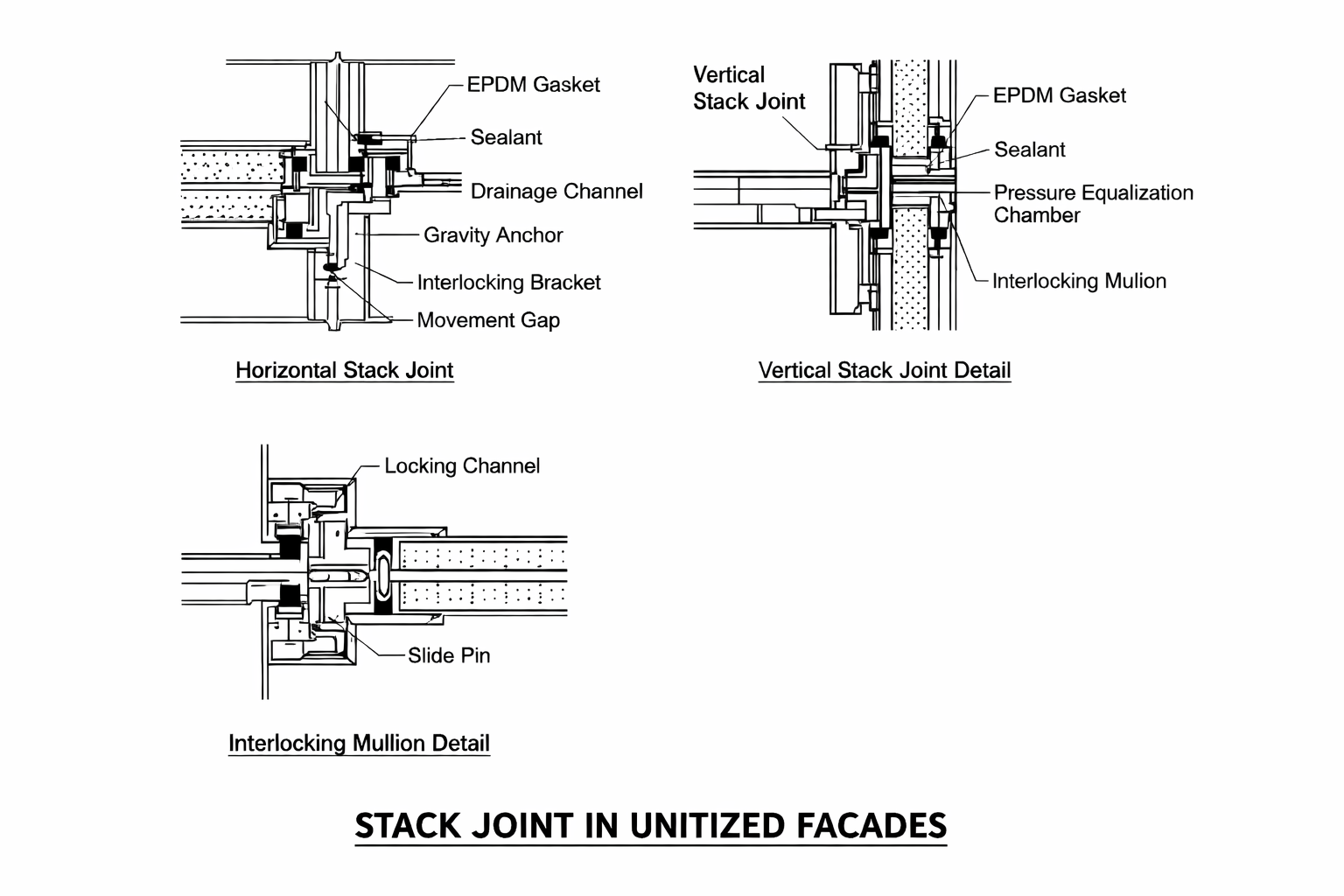
A stack joint in a unitized façade system is the horizontal or vertical connection where one pre-fabricated curtain wall panel is “stacked” and interlocked with the adjacent panel. In unitized construction, large façade modules are manufactured in the factory and then assembled on-site floor by floor. The stack joint is the critical interface that ensures structural continuity, weather tightness, and alignment between these modules.
Key Functions of a Stack Joint
Structural Transfer
It allows vertical dead load transfer (panel self-weight) and accommodates lateral loads from wind or seismic movement. Typically, gravity anchors support the panel weight, while stack joints help stabilize and align the system.Air & Water Tightness
Stack joints include EPDM gaskets, sealants, and pressure-equalized chambers to prevent air leakage and water ingress. Proper compression of gaskets during installation is essential for performance.Movement Accommodation
Buildings expand and contract due to thermal changes, live load deflection, and inter-storey drift. The stack joint is designed with tolerances and sliding connections to absorb these movements without damaging the façade.Ease of Installation
Unitized panels are installed from inside the building. The stack joint enables quick hooking and locking mechanisms, reducing scaffolding and improving safety.
Common Challenges
Improper alignment during installation
Insufficient gasket compression
Tolerance mismatch between slabs and panels
Sealant failure over time
In summary, the stack joint is the backbone of a unitized façade system, ensuring that individual panels function as a single, continuous building envelope while maintaining structural performance and weather resistance.