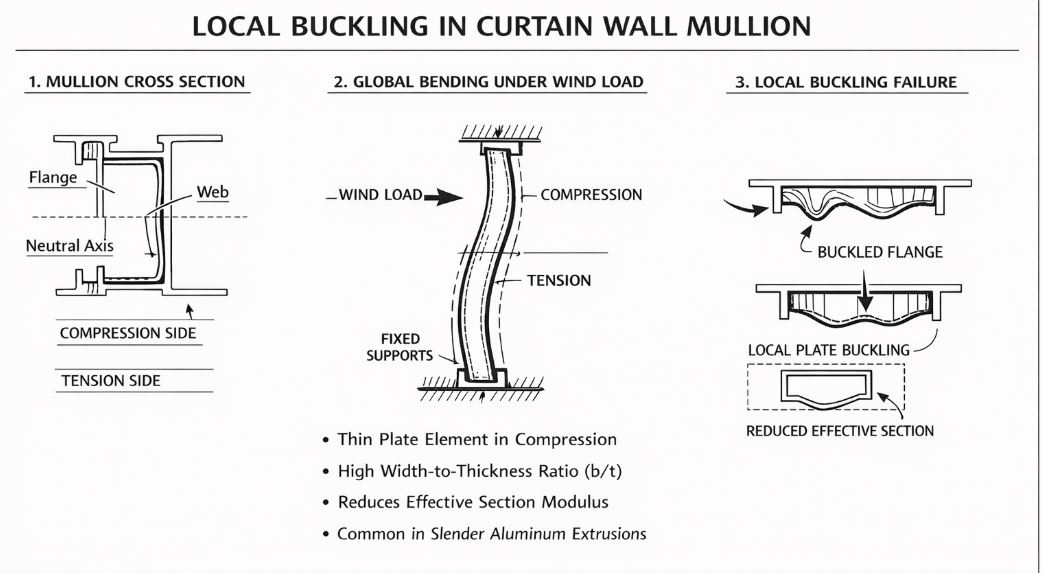
What is Local Buckling in Curtain Wall Mullions?
Introduction
In a curtain wall system, mullions are the primary vertical structural members that transfer wind loads and self-weight to the building structure. While global bending and deflection are commonly checked during design, another critical failure mode is local buckling — a failure that can occur even when overall stresses appear acceptable.
What is Local Buckling?
Local buckling is the instability of a thin plate element within a structural member, such as the flange or web of an aluminum mullion, under compressive stress.
Unlike global buckling (where the entire member bends or bows), local buckling affects only a portion of the cross-section. The thin walls of aluminum extrusions used in curtain walls are particularly susceptible.
Global buckling → Entire mullion bends.
Local buckling → Only the thin plate (flange/web) wrinkles or deforms.
Why Does Local Buckling Happen in Mullions?
Local buckling occurs due to a combination of the following factors:
High Compressive Stress
When wind load causes bending in a mullion:
One side of the section goes into compression
The opposite side goes into tension
Thin compression elements can suddenly deform if their thickness is insufficient.
High Width-to-Thickness Ratio (b/t Ratio)
This is the most critical reason.
If:
bt is large\frac{b}{t} \text{ is large}tb is large
Where:
b = width of plate element
t = thickness
Then the element becomes slender and unstable.
Thin aluminum sections used to reduce weight and cost often increase this risk.
Aluminum Material Behavior
Most curtain wall mullions use aluminum alloys such as:
6063-T6 aluminum
Aluminum does not exhibit a strong yield plateau like steel. Once local buckling initiates, load-carrying capacity can reduce quickly.
Concentrated Loads & Fixity Conditions
Anchor points
Splice locations
Bracket connections
Improperly designed stack joints
These create stress concentrations that accelerate local plate instability.
How Local Buckling Leads to Failure
When local buckling occurs:
Effective section modulus reduces
Moment capacity drops
Excessive deflection increases
Glass alignment may be disturbed
Sealant joints may fail
In extreme cases, it can cause permanent deformation of the mullion and compromise façade safety.
How to Prevent Local Buckling in Mullions
Increase Plate Thickness
Reducing b/t ratio improves stability.
Use Reinforced Sections
Add stiffeners or select profiles with internal ribs.
Check Slenderness Limits
Follow relevant standards like:
IS 800 (concept reference)
AAMA 501
Eurocode 9
(For aluminum façade members, Eurocode 9 or AA ADM provisions are commonly applied.)
Perform Proper Structural Analysis
Check compression flange stresses
Verify allowable stress vs critical buckling stress
Use FEA for complex sections
Conclusion
Local buckling is a critical but often overlooked failure mode in curtain wall mullions. It occurs when thin aluminum plate elements in compression lose stability before the entire member fails.
Proper control of:
Width-to-thickness ratio
Section geometry
Material selection
Load path detailing