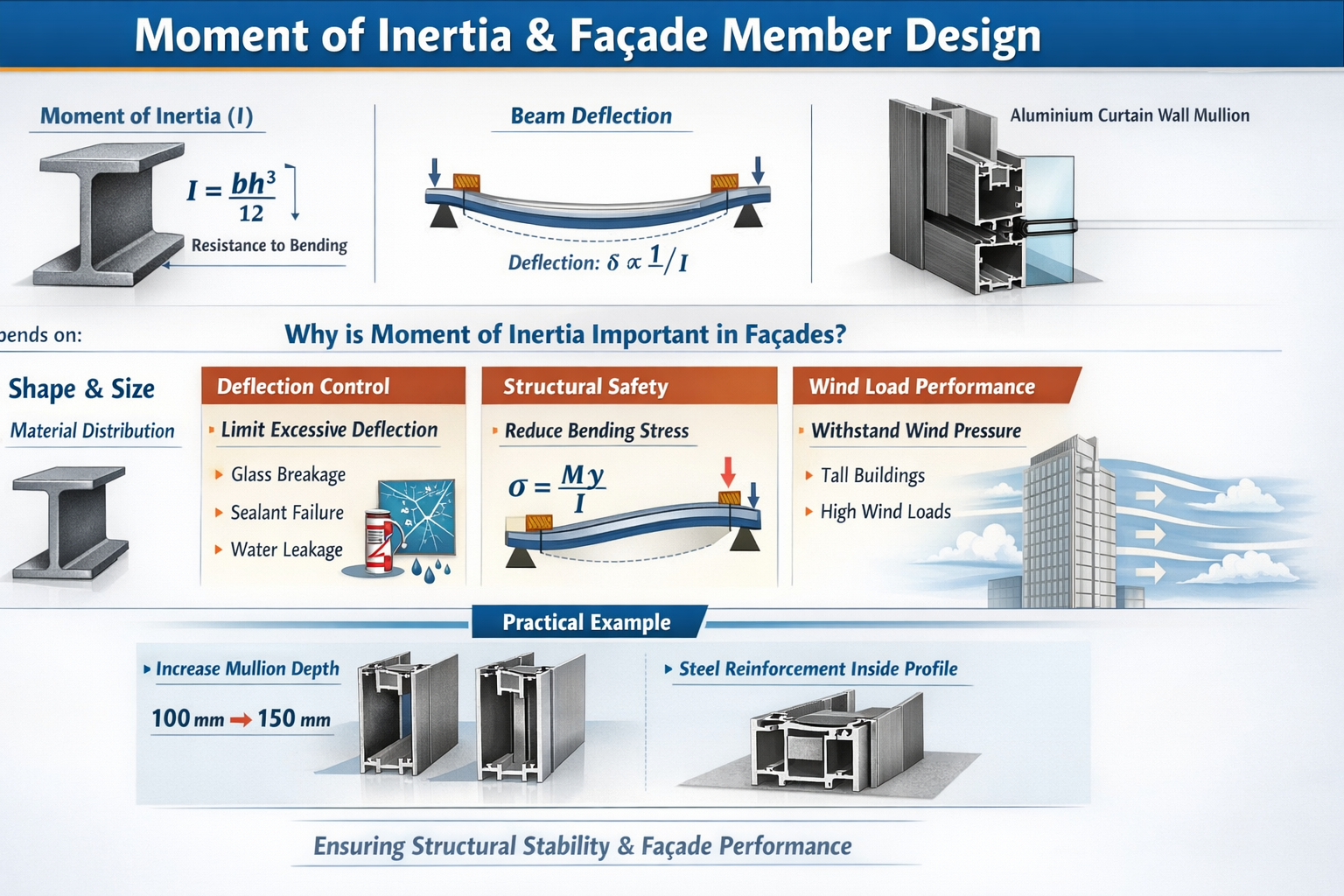
Moment of Inertia & Its Importance in Façade Member Design
What is Moment of Inertia?
The Moment of Inertia (I), also called the Second Moment of Area, is a geometric property of a cross-section that indicates how resistant a member is to bending.
It depends on:
The shape of the section
The size (depth & width)
The distribution of material away from the neutral axis
The more material placed farther from the center (neutral axis), the higher the moment of inertia and the greater the bending resistance.
Why is Moment of Inertia Critical in Façade Design?
In façade systems such as curtain walls, unitized panels, and structural glazing, members like mullions, transoms, brackets, and reinforcement profiles are subjected to:
Wind loads (positive & negative pressure)
Dead load of glass and panels
Live loads during maintenance
Thermal stresses
The moment of inertia directly affects:
Deflection Control
Deflection is inversely proportional to Moment of Inertia:
δ∝1I\delta \propto \frac{1}{I}δ∝I1
Higher I → Lower deflection
Lower I → Higher deflection
In façade design, excessive deflection can cause:
Glass breakage
Sealant failure
Water leakage
Misalignment of panels
Typical deflection limits:
L/175 or L/240 (depending on project specification)
Span/250 for serviceability (common in façade practice)
Structural Safety Against Bending
Bending stress:
σ=MyI\sigma = \frac{M y}{I}σ=IMy
Higher I reduces bending stress under the same load, improving safety and structural performance.
Wind Load Performance
For high-rise buildings, wind pressure increases with height.
Façade mullions must be designed with adequate I value to:
Resist wind pressure
Maintain glass pocket integrity
Prevent dynamic vibration
Practical Example in Façade Members
Increasing mullion depth from 100 mm to 150 mm can significantly increase Moment of Inertia.
Adding steel reinforcement inside aluminum profiles increases composite stiffness.
Choosing box sections instead of flat sections improves bending resistance.
Conclusion
Moment of Inertia is one of the most critical parameters in façade member design. It governs:
✔ Structural stiffness
✔ Deflection control
✔ Glass safety
✔ Long-term serviceability
✔ Wind load resistance