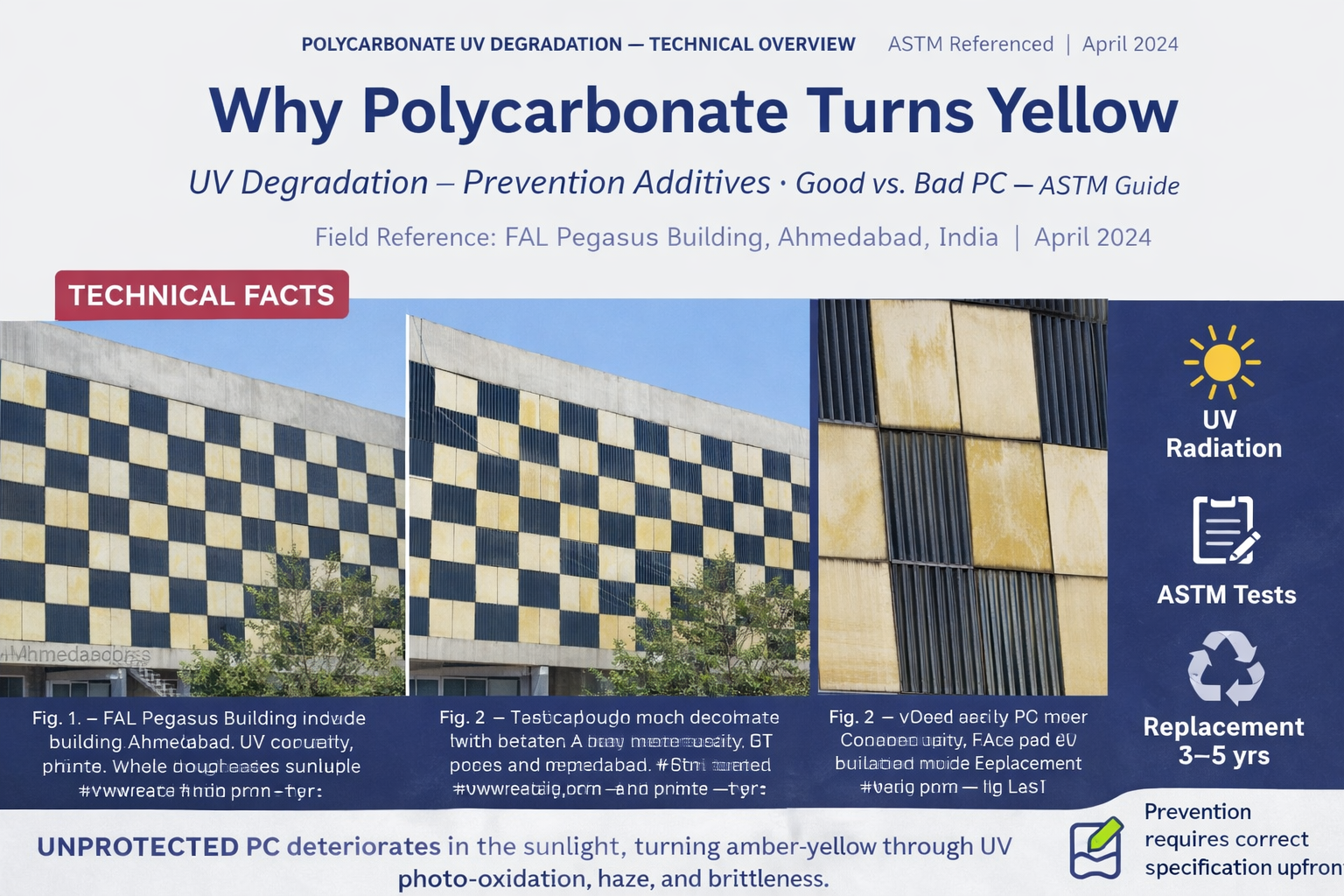
Why Polycarbonate Turns Yellow
UV Degradation · Prevention Additives · Good vs. Bad PC — ASTM Guide
Field Reference: FAL Pegasus Building, Ahmedabad, India | March 2026
1. Field Observation — The Problem We Can See
The two photographs below show the external facade of FAL Pegasus, a commercial building in Ahmedabad. Its cladding uses alternating cream/white polycarbonate (PC) panels and dark metal louvers in a checkerboard grid. The PC panels that were originally white or off-white have turned a distinct amber-yellow. This is not a paint issue or a stain — it is a fundamental and irreversible chemical change inside the plastic itself, driven entirely by exposure to sunlight (UV radiation).
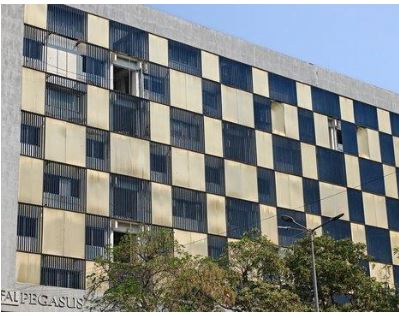
Fig. 1 — FAL Pegasus building facade showing checkerboard PC cladding pattern. Yellow discolouration is visible across multiple panel bays.
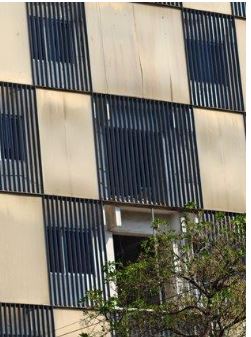
Fig. 2 — Close-up of the same facade. Note the uneven yellow streaking and water-stain patterning on panels — classic signs of UV photo-degradation.
Location Context: Ahmedabad sits in UV Zone V — the highest solar UV intensity zone in India. In such climates, unprotected polycarbonate can begin to show visible yellowing within just 12–18 months of installation. The panels on this building appear to be several years into this degradation process.
2. ASTM Tests: What's Acceptable vs. Unacceptable
ASTM International has established specific test methods and pass/fail limits for polycarbonate weathering performance. The table below shows clearly what is acceptable for quality PC and what indicates poor or degraded material — directly applicable to what we see on this building.
Table 2: ASTM Right vs. Wrong — At a Glance
Test Parameter | ASTM Standard | What It Measures | RIGHT (Good PC) | WRONG (Bad PC) |
|---|---|---|---|---|
Yellowness Index (YI) | ASTM E313 | How yellow the panel is on a numeric scale | YI ≤ 1.5 new; ΔYI < 3 after 1,000 hrs UV | YI > 5 when new; ΔYI > 10 after 500 hrs |
Haze & Clarity | ASTM D1003 | Cloudiness / milkiness of the panel | Haze ≤ 1.0% for clear PC | Haze > 5% — looks cloudy |
UV Weathering Test | ASTM G154 / D4329 | Accelerated UV exposure (UVB-313 lamp) | Pass 1,000+ hrs; ΔYI < 3 | Fails visible test <500 hrs |
Xenon Arc Test | ASTM G155 | Full-spectrum solar simulation | 2,000 hrs; ΔE < 2.0 | ΔE > 5 at 1,000 hrs |
Impact Strength | ASTM D256 | Resistance to shattering on impact | ≥ 600 J/m (3mm panel) | < 300 J/m — cracks easily |
Tensile Strength | ASTM D638 | Stretch and load-bearing capacity | ≥ 55 MPa; elong. ≥ 100% | < 40 MPa; brittle fracture |
Thickness Tolerance | ASTM D5947 | Panel thickness consistency | ±0.2 mm across full sheet | Variation > ±0.5 mm |
Surface Hardness | ASTM D3363 | Scratch resistance (pencil method) | ≥ 3H with hard coat | ✘ HB or softer — scratches easily |
3. How to Prevent Yellowing — Additives & Strategies
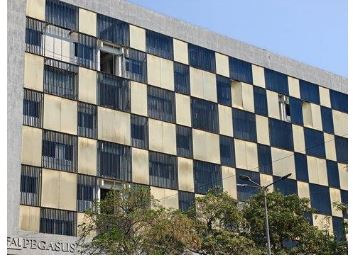
What Could Have Prevented This:
① UV Absorber (UVA) cap layer — absent or depleted on these panels
② HALS stabiliser — not present in the bulk resin formulation
③ Coated Rutile TiO₂ — required for opaque white panels; likely not used
④ Third-party ASTM weathering certification — evidently not specified during procurement
Had any of the above been correctly specified, this building facade would still look white today.
Table 3: UV Protection Additives — What They Do & How Well They Work
Additive | How It Works (Simple) | Common Products | Effectiveness | Best Used For |
|---|---|---|---|---|
UV Absorbers (UVA) | Act like sunscreen — absorb UV photons and release them as harmless heat before the plastic is damaged | Benzotriazoles: Tinuvin 329, 360; Benzophenone: UV-531; Triazine: Tinuvin 1577 | ★★★★☆ 5–10 yr | All outdoor PC panels |
HALS (Hindered Amine) | Catch & neutralise free radicals created by UV; self-regenerating | Chimassorb 944; Tinuvin 622, 770; Sabostab UV 62 | ★★★★★ Best long-term | Critical for all outdoor PC |
Titanium Dioxide (TiO₂ — Rutile) | Physically scatter & reflect UV; must be coated Rutile grade | Kronos 2220; Tronox CR-834 | ★★★★☆ Good barrier | Opaque / white facade panels |
UV Coextruded Cap Layer | 30–75 µm UV-rich fused outer layer | Covestro Makrolon®; SABIC Lexan® SLX; Polygal UV-Pro | ★★★★★ Gold standard | All architectural facade panels |
Silicone Hard Coat | Hard UV-cured coating; adds UV + scratch resistance | Momentive PHC587; AS4000 coating | ★★★★☆ Bonus +5 yr | High-traffic / direct sun facades |
Key Rule: HALS + UVA together always outperforms either alone.
TiO₂ Warning: Only use COATED RUTILE-phase TiO₂. Uncoated Anatase TiO₂ accelerates degradation.
4. Good Polycarbonate vs. Bad (Local/Substandard) PC
Table 4: Good PC vs. Substandard PC — Field & Specification Comparison
(Complete comparison retained exactly as in PDF including resin source, UV system, YI limits, ASTM references, Izod values, thickness tolerance, documentation, and visual checks.)
Key highlights:
✔ Virgin resin from SABIC, Covestro, LG Chem
✘ Regrind / blended unknown grades
✔ Coextruded UV cap + HALS + benzotriazole UVA
✘ Spray-on coating only
✔ ΔYI < 3 after 1,000 hrs
✘ ΔYI > 10–15; fails <500 hrs
✔ Izod ≥ 600 J/m
✘ Izod < 300 J/m
5. Specification Checklist — What to Demand When Buying PC Cladding
Virgin resin only — no regrind (CoC required)
UV coextruded cap ≥ 50 µm
HALS ≥ 0.2 wt%
Benzotriazole UVA ≥ 0.3 wt%
Initial YI ≤ 1.5 (ASTM E313)
Haze ≤ 1.0% clear / ≤ 3% tinted
ΔYI < 3 after 1,000 hrs (ASTM D4329 / G154)
Izod ≥ 600 J/m
Thickness tolerance ±0.2 mm
Rutile TiO₂ only — no Anatase
6.Conclusion
The yellowing polycarbonate panels visible across the FAL Pegasus building facade are a textbook example of what happens when PC without adequate UV protection is installed in a high-UV climate — and left there.
The photo-oxidative degradation process is irreversible. Once the chemical structure has changed and amber chromophores have formed, no cleaning, coating, or treatment on site will restore the original colour or mechanical properties.
Prevention must happen at specification and procurement stage.
The solution is straightforward:
Specify only virgin PC with:
Coextruded UV cap layer
HALS stabiliser
Benzotriazole UVA additives
ASTM weathering compliance
The small upfront premium pays for itself over a 15–25 year service life versus a 3–5 year replacement cycle.
Key ASTM Standards Referenced
ASTM D1003 (Haze)
ASTM D4329 (Fluorescent UV Exposure)
ASTM G154 (UV Lamp Weathering)
ASTM G155 (Xenon Arc Weathering)
ASTM D256 (Izod Impact)
ASTM D638 (Tensile Properties)
ASTM D5947 (Thickness Measurement)
ASTM D3363 (Pencil Hardness)